
Strait of Hormuz: Fashion’s New Black Swan

Strait of Hormuz: Fashion’s New Black Swan
India’s Strategic Role in Supply Chain Amid Strait of Hormuz Risks

NoName Clothing Manufacturers
Strait of Hormuz disruption is driving up costs, delaying shipments, and forcing fashion brands to rethink supply chains for resilience and survival.
What began as regional instability in a critical trade route has evolved into a defining black swan event for the industry. The resulting shock to supply chains is being compared to the disruptions experienced during the peak of the COVID-19 pandemic.
For brands across the United States, the United Kingdom, and the Middle East, the impact is becoming increasingly visible. Costs are rising sharply, delivery timelines are slowing, and supply chains are becoming harder to manage. The industry is facing a new reality where a 33-kilometre-wide waterway plays a decisive role in the movement of global fashion.
A Perfect Storm: What’s Driving the Disruption
The current crisis is not driven by a single factor. It is the result of multiple pressures converging at the same time, creating a complex and difficult environment for fashion brands.
One of the primary drivers is the surge in energy prices. As of March 2026, crude oil has crossed 120 dollars per barrel. This has directly increased the cost of petrochemical-based raw materials used in apparel production.
In India, a key hub for garment manufacturing, Polyester Staple Fibre prices have risen significantly, while Purified Terephthalic Acid has recorded increases of over 25 per cent. These cost escalations are affecting production at the very source.
At the same time, global logistics disruptions are intensifying the situation. According to UNCTAD, disruptions in major trade routes can increase shipping costs by 30 to 50 per cent while also causing significant delivery delays. Together, these factors are forcing brands to rethink traditional sourcing strategies.
The Synthetic Trap: Fashion’s Dependence on Oil
The fashion industry’s reliance on synthetic fibres has created a deep vulnerability to oil price fluctuations.
Materials such as polyester, nylon, and acrylic are all derived from petroleum. Polyester alone accounts for more than 50 per cent of global fibre production, making it the most widely used material in the industry.
As oil prices rise, fabric costs increase almost immediately. This has led to what industry experts describe as a “synthetic trap,” where brands face unavoidable increases in raw material costs.
The impact extends beyond fabrics. Packaging components such as polybags, trims, and hangers are also affected due to their reliance on petrochemical inputs. Recent industry insights indicate that these secondary costs have increased by up to 20 to 25 per cent.
This layered cost escalation is putting significant pressure on brand profitability, particularly for businesses operating on low margins.
The 25-Day Delay: A Global Logistics Reset
Shipping disruptions are adding a critical time challenge to the ongoing cost pressures.
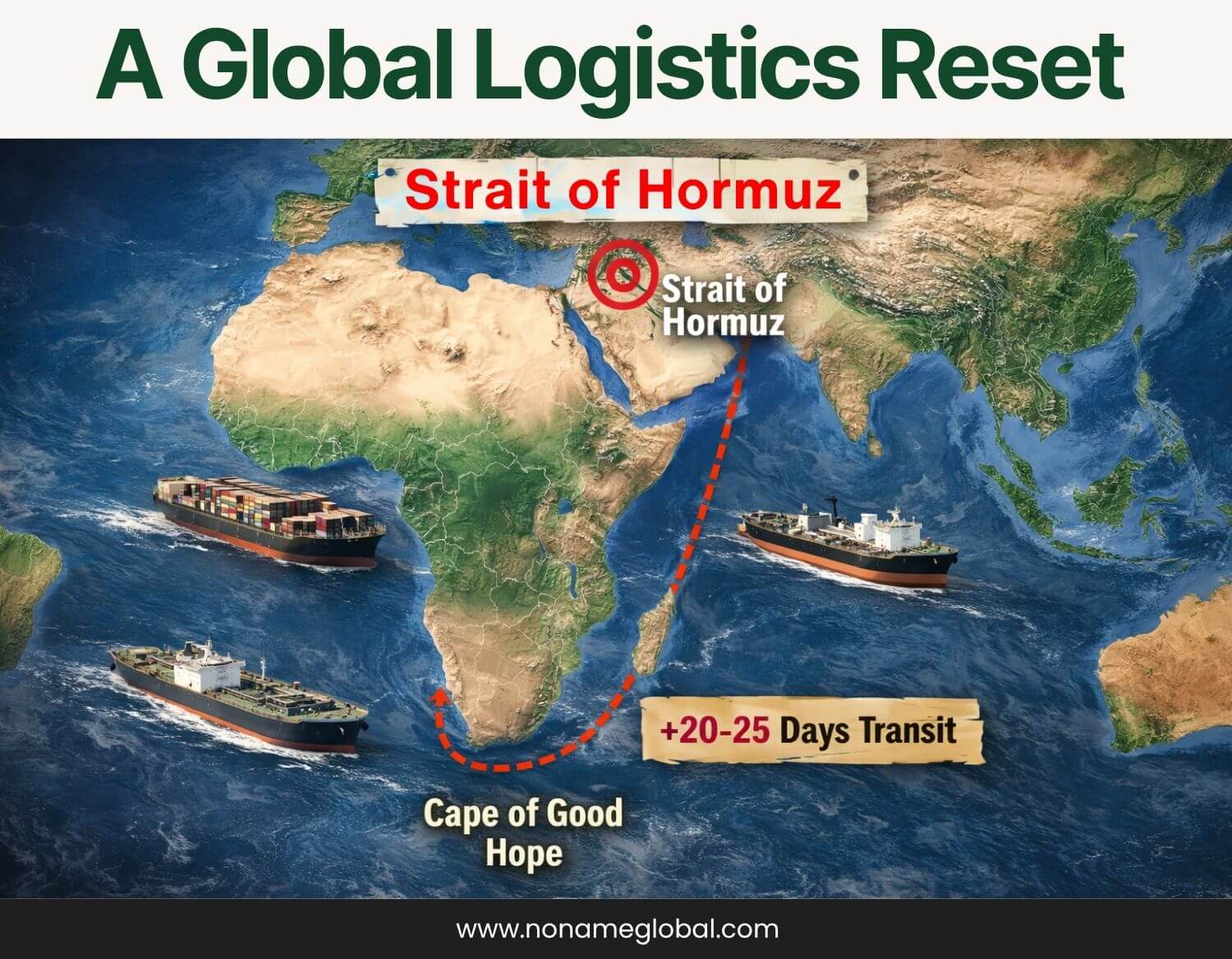
Due to security risks in the Strait of Hormuz, many vessels are rerouting via the Cape of Good Hope. This change is adding 20 to 25 days to transit times.
For the fashion industry, where timing is closely tied to seasonal demand, these delays are highly disruptive. According to Drewry Shipping Consultants, rerouting can increase transit times by up to 30 per cent.
A delay of this scale can result in missed retail windows, excess inventory, and heavy discounting. At the same time, freight costs have surged, with container rates reaching up to 4000 dollars due to additional surcharges and insurance costs.
Brands are now facing a dual challenge of higher costs and slower deliveries.
Factories Under Strain: The Energy and Cost Crunch
The disruption is also placing significant pressure on manufacturers.
Energy-intensive processes such as spinning, dyeing, and finishing are becoming more expensive due to rising fuel costs and limited availability of industrial gas. In India, this has led to operational cost increases and margin compression of up to 20 per cent for many manufacturers.
Compounding the issue, many production contracts were signed before these cost increases. As a result, manufacturers are often unable to pass on the additional expenses, forcing them to absorb the financial impact.
This situation highlights the growing strain on the manufacturing base that supports global fashion supply chains.
India’s Strategic Role in a Changing Supply Chain Amid Strait of Hormuz Risks
Amid ongoing disruptions, India is emerging as a strategic solution for global brands.
The country’s integrated textile ecosystem allows for the production of both natural and synthetic materials within its borders. This reduces dependence on external supply chains that are currently facing instability.
India’s end-to-end capabilities, from fibre production to finished garments, provide a level of supply chain control that is increasingly valuable. Government initiatives such as the Production Linked Incentive scheme and PM MITRA textile parks are further strengthening this position.
NoName is actively supporting international partners by offering flexible minimum order quantities, diversified sourcing options, and consistent production quality. These capabilities help brands maintain continuity despite ongoing disruptions.
A New Reality: Rethinking Fashion Supply Chains
The disruption in the Strait of Hormuz is not a short-term issue. It represents a broader shift in how global supply chains operate.
Traditional models focused on cost efficiency are proving insufficient in a volatile environment. Brands must now prioritize flexibility, diversification, and long-term resilience.
Failure to adapt may result in rising costs, delayed product launches, and increased uncertainty in planning.
The events of 2026 have reinforced a critical lesson for the industry. The most expensive garment is not the one made with premium materials. It is the one that arrives too late to be sold.
About NoName
NoName is a globally trusted garment manufacturer based in India, offering flexible minimum order quantities, high-quality production, and end-to-end manufacturing solutions. Serving brands across the United States, the United Kingdom, and the Middle East, NoName focuses on compliance, transparency, and operational excellence to help build resilient and future-ready supply chains.
Pankaj Agrawal
Celestial Corporation
+91 96505 08508
pankaj@celestialfix.com
Visit us on social media:
LinkedIn
Instagram
Facebook
YouTube
Strait of Hormuz: Fashion’s New Black Swan
Legal Disclaimer:
EIN Presswire provides this news content "as is" without warranty of any kind. We do not accept any responsibility or liability for the accuracy, content, images, videos, licenses, completeness, legality, or reliability of the information contained in this article. If you have any complaints or copyright issues related to this article, kindly contact the author above.
